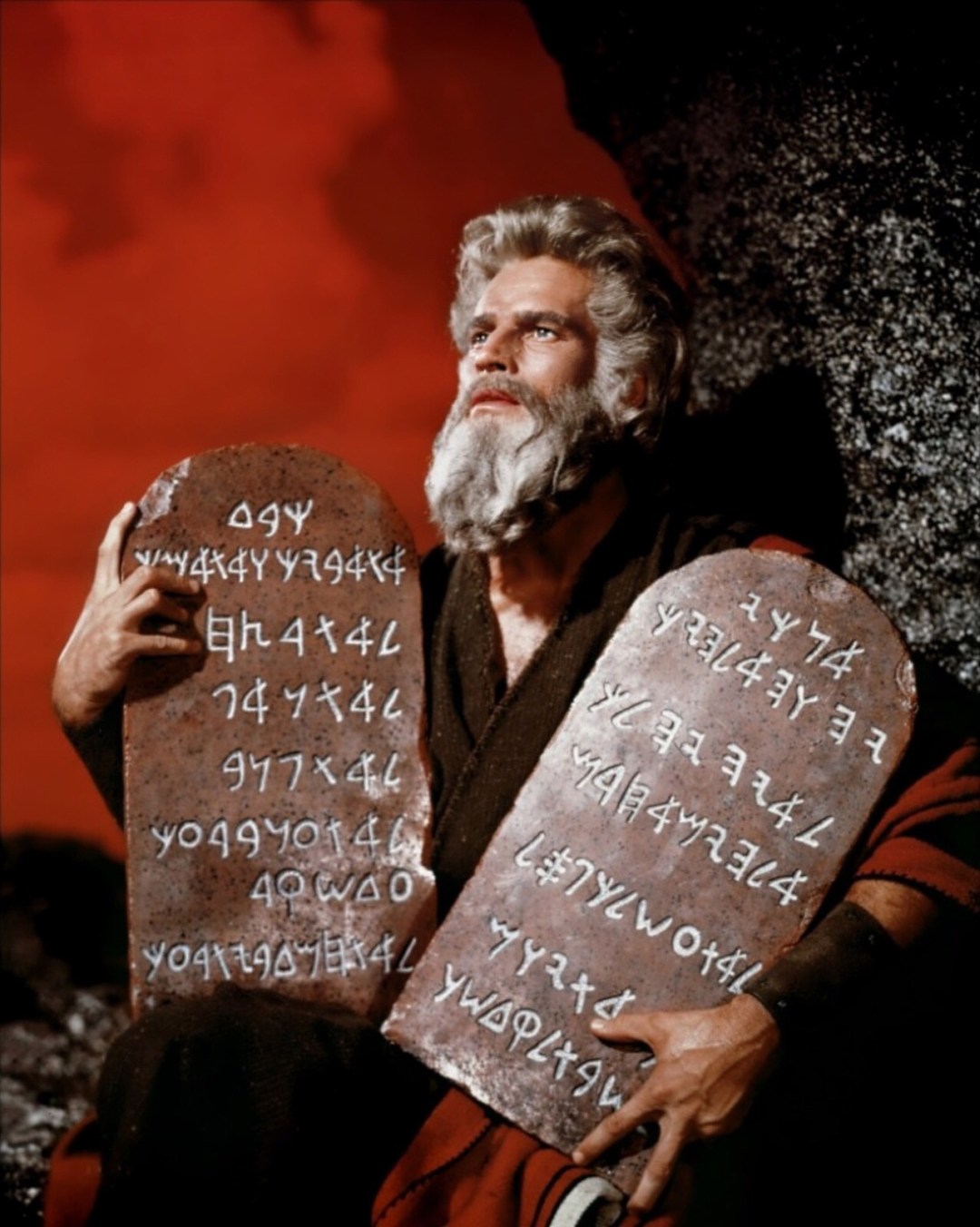
Today’s reading contains one of the most pivotal Scriptures in the Old Testament: Israel’s arrival at Mt. Sinai and the delivery of the Ten Commandments. As Israel arrives at Sinai, God gives Moses specific instructions about how the Israelites should respect and recognize the boundaries related to God’s manifest presence. No one but Moses, and then Aaron with Moses, can touch the mountain, and only Moses can go up into the absolute presence of God. God even warns that those who do not obey these restrictions will be killed. Moses also requires a commitment from Israel to overy whatever God speaks to them. They give that explicit agreement. Before God can do anything meaningful in our lives, we must agree to obey Him and follow His leadership.
Then the glory of God, in the form of a cloud, descends on the mountain and Moses goes up to meet with God. Once Moses is on the mountain, God gives him the commandments:
20:1 And God spoke all these words, saying:
2 “I am the Lord your God, who brought you out of the land of Egypt, out of the house of bondage.
3 “You shall have no other gods before Me.
4 “You shall not make for yourself a carved image—any likeness of anything that is in heaven above, or that is in the earth beneath, or that is in the water under the earth; 5 you shall not bow down to them nor serve them. For I, the Lord your God, am a jealous God, visiting the iniquity of the fathers upon the children to the third and fourth generations of those who hate Me, 6 but showing mercy to thousands, to those who love Me and keep My commandments.
7 “You shall not take the name of the Lord your God in vain, for the Lord will not hold him guiltless who takes His name in vain.
8 “Remember the Sabbath day, to keep it holy. 9 Six days you shall labor and do all your work, 10 but the seventh day is the Sabbath of the Lord your God. In it you shall do no work: you, nor your son, nor your daughter, nor your male servant, nor your female servant, nor your cattle, nor your stranger who is within your gates. 11 For in six days the Lord made the heavens and the earth, the sea, and all that is in them, and rested the seventh day. Therefore the Lord blessed the Sabbath day and hallowed it.
12 “Honor your father and your mother, that your days may be long upon the land which the Lord your God is giving you.
13 “You shall not murder.
14 “You shall not commit adultery.
15 “You shall not steal.
16 “You shall not bear false witness against your neighbor.
17 “You shall not covet your neighbor’s house; you shall not covet your neighbor’s wife, nor his male servant, nor his female servant, nor his ox, nor his donkey, nor anything that is your neighbor’s.”
I will not try to address each of these commandments individually here, but I would like to make a few observations. God’s presence on Sinai was a powerful manifestation of God’s Spirit that was not to be taken lightly. The people of God were to honor the presence of God under penalty of death. When you worship, worship in reverence and submission. Do not demand of God or even presume to instruct Him. Rather, lay your offering before Him in fear and awe.
Concerning the commandments, it is interesting to note just a few things. First, the first four commandments relate to our relationship with God. He must be the only God. There can be no other idols in our lives. Respect the name of God. Respect the day (worship) of God. Simple, yet reasonable responses to the God of our Creation and Salvation. Second God gives us six commandments relating to our relationship with other people. Honor your parents. Honor life. Honor marriage. Honor others’ property. Honor truth. Honor boundaries. These give us great spiritual and practical ways to behave toward our fellow man or woman.
While these are not deep theological musings on the ten commandments, suffice it to say that we need to implement these truths in our daily lives, and simplifying them can be very helpful. Help us, Lord to obey the voice of the Lord!

 Devoted To You