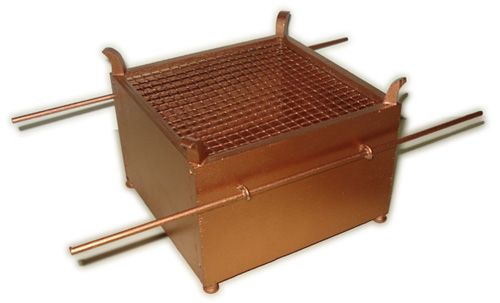
The Altar was to be constructed of acacia wood and overlaid in bronze, 7 1/2 feet square and 4 1/2 feet tall. It would have four horns, one on each corner, and pans underneath to catch the ashes of the burnt offering. The pans, shovels, basins, and forks would be made of bronze as well. There would be a grate underneath, and rings on the four corners by which to carry the altar with poles.
The Court of the Tabernacle surrounded by hangings, 150 feet on the North and the South. They would be hung on bronze pillars and hooks. The hangings for the East and West would be 75 feet. Within the East side would be a gate with a screen 30 feet long.
The altar would be the place where all the offerings unto God would be offered. It was like a large wood grill that would be used to burn (or cook) the offerings once they were offered unto the priests and killed by the priests. This practice of offerings for the forgiveness of sins, among other things, would be the type, or forerunner, of the lamb of God, Jesus Christ, who was slaughtered by the priesthood of the Jews for the sins of the world. He was the Passover Lamb.
The courtyard would be the place where all people could come to offer sacrifice unto God. Only the priests could enter the holy place, and only the High Priest could enter the Most Holy or the Holy of Holies. This arrangement of the tabernacle would represent the pattern of worship for all times. One enters the house of God with a repentant heart, seeking cleansing and forgiveness of sins, then enters into the holy place to dwell in His presence. Finally, the worshipper would go into the Most Holy place, where God would examine his or her soul and perfect him or her in the presence of God.
We must approach God with humble, penitent hearts, open to His transforming Spirit. The tabernacle gives us a shadow of the pattern of worship by which God’s people must approach him. Although this passage just gives the outward dimensions of the tabernacle and some of its most important items, there will be other items described as we go forward that will flesh out the picture of the pattern of worship.

 Devoted To You